Showing posts with label market timing for homes. Show all posts

Rising Interest Rates Expected to Impact Homebuyer Traffic

Real estate agents are divided on whether rising interest rates will have a negative impact on home purchase activity. Average interest rates on 30-year fixed-rate mortgages increased significantly in June, according to Freddie Mac, from 3.54% in May to 4.37% on July 18.

“As interest rates rise coupled with rising sale prices many buyers are falling out of the market,” according to an agent in California. An agent in Washington state said rising interest rates are both motivating buyers and keeping some potential buyers from being able to purchase a home.
Analysts at CoreLogic said even with recent home price gains, affordability remains near record levels in many markets across the country. “For housing price affordability to return to the average level that we saw between 2000 and 2004, either home prices would have to rise an additional 47% or interest rates rise to 6.75% ,” the firm said.

Sam Khater, senior economist at CoreLogic, predicted that rising interest rates won’t deter a significant number of potential home buyers. “Given the very high home affordability levels and more supply on the market, CoreLogic remains optimistic that rising rates and home prices will not dissuade the more traditional buyer from entering the market and financing a home purchase,” he said.

After a strong spring home buying season, the growth rate of buyer traffic continued to decline in
June, according to results from the latest Campbell/Inside Mortgage Finance HousingPulse Tracking Survey. Traffic from current homeowners and first-time home buyers outpaced traffic from investors for the sixth consecutive month, according to home buyer traffic diffusion indexes. Some investors have started to reduce their home purchase activity and sell properties due to concerns about potential home price declines.

“It’s a seller’s paradise: abundance of buyers, shortage of listings,” according to an agent in Texas. “The property values are steadily rising and multiple offers occur frequently. I have investors who troll the listings for REOs and they are making offer s at a much less frequent pace. And the prices they are paying are closer to asking price, if not over asking price.

Current homeowners and first-time home buyers are focusing on non-distressed properties, with the market showing continued signs of strength. Average time on market for non-distressed properties was falling steeply in June, the average number of offers for non-distressed properties remained high, and sales-to-list price ratios on non-distressed properties were at elevated levels.

Nationwide, the average time on market for non-distressed properties was 8.6 weeks in June, based on the three-month moving average, down from 12.1 weeks in December. Western states had the lowest average time on market in June, led by California where non-distressed
properties averaged 4.5 weeks on the market before selling.

Nationally, non-distressed properties received an average of 2.3 offers in June, based on the three
month moving average. Average offers on non-distressed properties have steadily trended upwards since the fall of 2010 when they averaged 1.7 offers. And sales-to-list price ratios on non-distressed properties increased for six consecutive months, hitting 97.9% in June, based on the three-month moving average. In December 2012, sales-to-list price ratios for non-distressed properties were at 95.6%, based on the three-month moving average, closer to the baseline ratio of 95.0% seen from June 2010 through June 2012.

Source:Housing Trends Update July 2013
Is it a Good Time to Buy or Sell Real Estate?

Rarely does a day go by that I don’t get asked if this is a good time to buy and/or sell a home. Some people might think that my response is always an emphatic “YES!” because I work in real estate. But in truth, there is no right or wrong answer. Every person’s circumstances are unique, so in some cases the answer might be yes, but for others it might make more sense to wait.

The good news is that we’re finally coming out of the housing slump of the past five-plus years. Housing is a major driving factor of the U.S. economy, so regardless of whether or not one owns a home, a stronger housing market is good for everyone. For some would-be home sellers, this positive momentum, combined with a rise in home prices and buyer activity, is enough to compel them to list their home. And right now the statistics appear to be on their side.

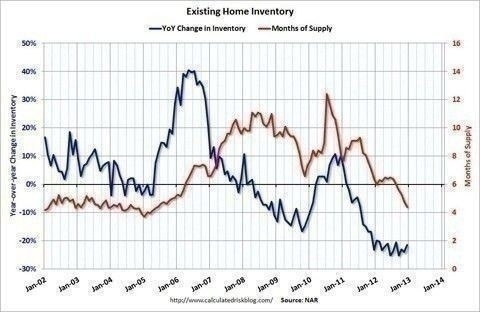
According to the most recent findings from the National Association of REALTORS®, total housing inventory has fallen for the past several months, settling at just under two million existing homes on the market that are available to buyers. This represents about a four-month-supply of homes throughout the U.S. This is the lowest housing supply the nation has seen since May of 2005 – during the peak of the housing boom.

“Months supply” basically means that if existing homes were to continue selling at the current rate, the inventory of homes would be sold by that many months. A “normal” market usually has around six months of supply; therefore lower numbers mean a shortage of inventory. If demand is greater than supply, this often leads to competition amongst buyers and rising prices. 

The following graph demonstrates the downward trend in the overall U.S. month’s supply of homes which is currently at about 4.4 months:
Existing-Homes-Chart [1]
As long as inventory levels remain low, competition amongst buyers will remain high, and home prices should continue to rise – albeit at a healthy rate – not like what we saw during the housing boom in some areas. As evidence of this, in the recent Home Price Expectation Survey, 105 leading housing analysts called for a 3.1 percent increase in home values by the end of 2013. And in a recent report by the National Association of REALTORS®, median home prices last quarter showed the strongest year-over-year increase in seven years.

Another thing that buyers and sellers need to keep their eye on is interest rates and their impact on affordability. Interest rates have been at such historical lows for so long that it’s easy to take them for granted. But the truth is that several lending institutions, including Freddie Mac and the Mortgage Bankers Association, project that interest rates will rise from 3.4 to 4.4 percent by the end of 2013. A full point increase can have a significant impact on the amount of your mortgage over the long term.

With these types of projections, one might wonder why there isn’t a flood of homes coming on the market. The biggest concern I hear from many would-be sellers is that they’re going to lose money because their home is worth less today than when they bought it. A valid concern, to be sure, but not necessarily the case for many folks. Remember, you’re buying and selling in the same market conditions, so if your home has lost value in recent years, it is highly likely that the next home you buy has as well.

Source: Ob Jacobi / Rismedia